
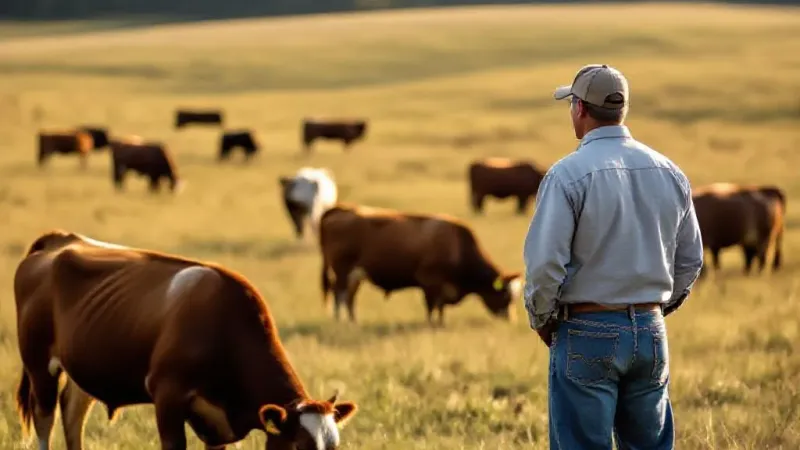
President Donald Trump's recent plan to import 300,000 metric tons of beef priced under market value has drawn strong criticism from Alabama agricultural organizations and politicians, who fear a negative impact on the state's domestic cattle industry. The proposal, which President Trump stated was intended to address high beef prices, has prompted rare rebukes from groups that typically support him.
The Alabama Cattlemen’s Association (ACA) has been vocal in its opposition. Erin Beasley, Chief Executive Officer for the ACA, stated on social media last month that introducing subsidized foreign beef to the market discourages cattlemen from investing in their operations, thereby slowing herd rebuilding. Beasley emphasized that the administration should instead focus on policies that encourage herd expansion and lower input costs, which have burdened the industry. She called the announcement "another slap in the face for cattlemen everywhere," especially for the organization's more than 10,000 members. The ACA reported in January 2026 that Alabama farms held 1.2 million head of cattle and calves.
In response to the plan, U.S. Rep. Shomari Figures, D-Mobile, introduced legislation last week aimed at nullifying the President's proclamation. Figures' proposed bill would prevent the president or other elected officials from suspending, waiving, or reducing any tariff, fee, or duty on beef products unless Congress first approves such actions. In an interview last week, Representative Figures expressed surprise at President Trump's perceived lack of understanding regarding the challenges facing cattle farmers and the agriculture industry as a whole. He further noted that several administration actions have displayed a similar "lack of understanding or just simply not caring about the impact of their policies on farmers." Figures is currently seeking re-election in a district redrawn in May to favor Republicans.
Rep. Rhett Marques, R-Enterprise, the Republican nominee for Alabama’s 2nd Congressional District, did not make a public comment on the proclamation last week. A message seeking comment was left with Marques Friday afternoon.
Amid the public outcry, President Trump signed an executive order Friday afternoon. This order aims to simplify the process for ranchers and farmers to process their own beef products and sell them directly to consumers. However, this approach faces opposition from certain organizations, such as the National Cattlemen’s Association, which cites food safety concerns regarding the sale of products without inspection.
Rick Pate, Alabama’s Commissioner of Agriculture and Industries, also weighed in on the proclamation. He stated that the measure is "unlikely to provide lasting relief" due to its temporary nature. Commissioner Pate noted that demand for beef remains strong despite higher prices. He explained that if prices climb too high, consumer demand will eventually ease, leading to price adjustments and producers retaining more heifers. Pate concluded that while he understood the intent behind federal actions, "market forces will ultimately determine long-term outcomes."
The beef import plan and its potential impact come as ground beef prices have seen significant increases. Federal Reserve Economic Data indicates that ground beef prices first spiked in June 2020 to $4.74 per pound, then dropped to $3.96 per pound by December 2020. As of July 2026, ground beef prices stand at $6.86 per pound. These higher prices are likely due to a smaller national cattle herd, according to USDA reports. The USDA stated that at the beginning of the year, there were 86.2 million head of cattle, a slight decrease from 86.5 million head in January 2025. The agriculture sector plays a significant role in Alabama's economy; the Alabama Cooperative Extension System reported in 2022 that 273,271 jobs in Alabama’s food, fiber, forestry, and green industries accounted for 10% of the state’s workforce.