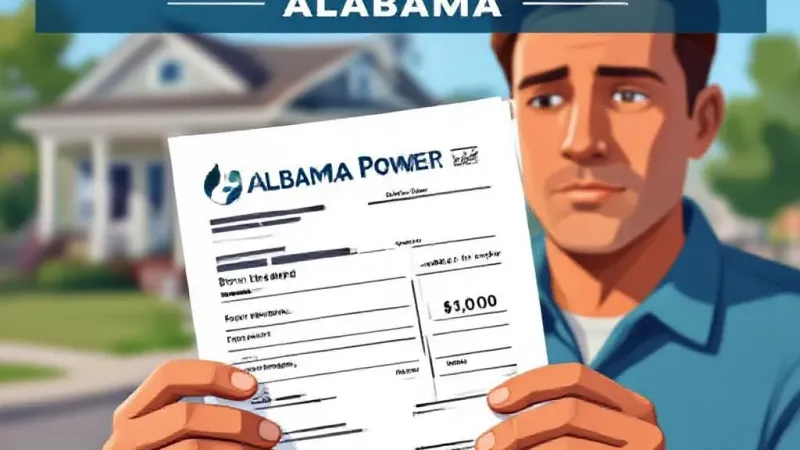
Alabamians face some of the highest residential power prices in the Southern United States, making the Attorney General’s potential role in regulating these rates a significant concern in the current election.
State law grants the Alabama Attorney General the authority to intervene in rate cases before the Alabama Public Service Commission (PSC) on behalf of the public. However, this power was rarely used for decades, as the PSC has employed a process since 1982 that effectively ensures a profit for utility companies. This summer marked a shift, with the Attorney General's office stepping into a case involving a natural gas company.
According to the Energy Information Commission, Alabama residents paid 16.04 cents per kilowatt-hour for electricity in June, exceeding the regional average of 14.89 cents.
Jeff McLaughlin, the Democratic nominee for Alabama Attorney General, stated on Monday that he would take the obligation to represent power customers "very seriously." He emphasized his commitment to ensuring residents pay fair prices for electricity and other services, and to addressing concerns about the environmental and energy footprint of data centers within communities.
McLaughlin asserted that the Attorney General's Office should be a strong advocate for ratepayers. He noted that it has been "some 40 years" since a significant rate case concerning Alabama Power, suggesting that the AG's Office ought to be more proactive in representing ratepayers.
Beyond rate cases, McLaughlin expressed a desire to slow the expansion of data centers, citing their substantial energy consumption and potential to drive up electric bills. He indicated that his office would support establishing regulations on how communities can protect themselves if a data center is not wanted, putting the office's weight behind ensuring careful consideration of these facilities.
Messages sent to the campaign of Katherine Robertson, the Republican nominee for Attorney General, on Tuesday and Wednesday seeking comment were not returned. Robertson, who currently serves as chief counsel for Alabama Attorney General Steve Marshall, has a campaign website that focuses on supporting President Donald Trump and law enforcement, without including a section on utility issues.
Recent actions by the Attorney General's office, however, demonstrate a more active stance. Earlier this year, the office challenged the rate of return requested by Spire Energy, a natural gas company, with the PSC. The PSC Board ultimately sided with the Attorney General's recommendation, approving a 9.4% return on equity for the company instead of the requested 10.5%.
In August, the Attorney General's office also submitted a comment to the PSC, arguing that board members, not staff, must vote on whether to approve contracts between energy companies and data centers. This suggests a push for greater oversight of energy deals involving large consumers.
The issue of power rates and data centers has also become part of the ongoing Governor's race. Tommy Tuberville, the Republican nominee for Governor, has expressed a desire to extend an existing rate freeze voluntarily proposed by Alabama Power beyond its 2029 expiration date. In contrast, Doug Jones, the Democratic nominee for Governor, advocates for the PSC to hold formal hearings on any proposed rate increases by Alabama Power, stating that current frozen rates are already too high.
Jones has also called for a one-year moratorium on the construction of new data centers. Tuberville, while initially dismissive of criticisms regarding data centers, opposes a moratorium but said he would work to ensure data centers compensate communities for their impacts.
Daniel Tait, executive director of Energy Alabama, an organization promoting renewable energy, underscored the important role of the Attorney General's Office in advocating for ratepayers. Tait explained that the AG's Office, with its access to unredacted filings and more data than the general public, is uniquely positioned to understand what should be happening with utility rates beyond what power companies present.
"The Attorney General’s Office gets access to a lot more information that is not made public," Tait said, highlighting the office's critical function in providing transparency and oversight in rate decisions given the profit motives of utility companies.