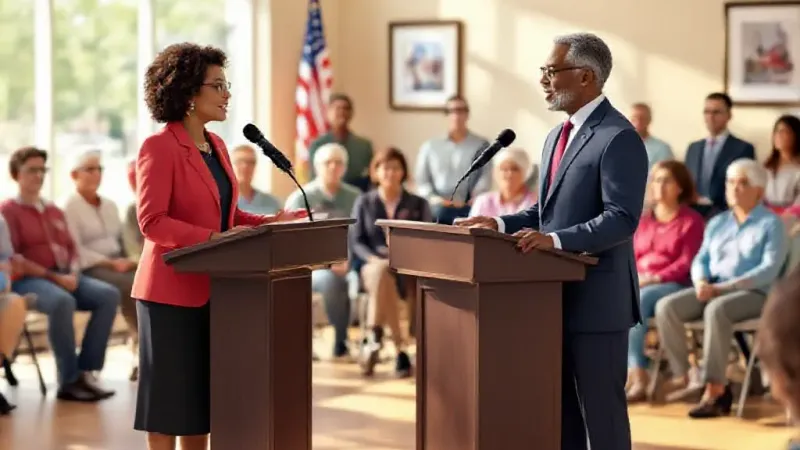
The constitutional office of Alabama Secretary of State is responsible for administering the state’s elections, registering voters, handling business registrations, and maintaining primary state records. Republicans have held this office since 2007, and the current Secretary of State, Wes Allen, elected in 2022, is not seeking re-election as he runs for lieutenant governor. The upcoming election features two candidates with distinct approaches to the office: Republican nominee Caroleene Dobson and Democratic nominee Wayne Rogers.
Caroleene Dobson, 39, secured the Republican nomination after winning against two other candidates and the subsequent withdrawal of Republican State Auditor Andrew Sorrell. Dobson, who was also the 2024 GOP nominee for the 2nd Congressional District, outlined her main priorities in a May interview on WFSA: securing elections and strengthening Alabama's economy. Drawing on her experiences in the 2024 race, she observed that while existing election integrity procedures and laws are sound, there remains work to be done. Dobson aims to ensure elections are fully secure, voter rolls are completely accurate, and the state is protected from external activist influences from outside Alabama.
Beyond election security, Dobson plans to streamline services, reduce fees, and improve accessibility for starting businesses in the state. If elected, she proposes creating an “election integrity and securities” division within the Secretary of State’s office, inspired by Florida’s Election Crimes and Security. Dobson highlighted that the current office lacks a dedicated branch to administer election laws, provide guidance on election procedures, or investigate claims of election fraud. However, election fraud in Alabama is extremely rare; the Heritage Foundation, a conservative think tank, reported 41 convictions or findings of voting fraud in the state since 2000. In comparison, over 2.2 million votes were cast in the 2024 presidential election in Alabama. Dobson did not explicitly endorse early in-person voting but emphasized the importance of a functional absentee ballot system for essential workers, such as truckers and healthcare personnel, who cannot vote in person on Election Day. She stressed the importance of a secure chain of custody for absentee ballots, involving only the probate judge and the voter. Currently, absentee voting is limited to specific groups of voters, including the elderly, those registered in Alabama but living outside their county (like college students or deployed service members), and those with scheduled shifts longer than 10 hours on Election Day.
Wayne Rogers, 64, ran unopposed in the Democratic primary. A first-time political candidate, Rogers discussed his priorities in a recent phone interview, which he refers to as the “Alabama Voting Rights Act.” Rogers stated his proposals are designed to make voting easier for residents, clarifying that he is not advocating for non-citizens to vote. He referenced recent U.S. Supreme Court decisions, including *Louisiana v. Callais*, which he believes significantly undermined the national Voting Rights Act. According to the source, this decision weakened Section 2 of the 1965 Act, requiring plaintiffs to demonstrate lawmakers' intent to discriminate rather than just the discriminatory effect of legislative maps. This ruling influenced Alabama, leading to a special legislative session to establish the framework for the state’s 2024 congressional maps, which federal judges and the U.S. Supreme Court had previously struck down multiple times in the *Allen v. Milligan* case before *Callais*.
Rogers’ proposed local voting rights act includes re-establishing no-excuse absentee voting and opening polls on the Saturday before an election. He expressed that providing two days for voting could make the process more convenient and potentially increase voter turnout by 15 to 20 percent. Another proposal is to allow 16-year-olds to pre-register to vote when they obtain their driver’s licenses, with their registration becoming active at age 18. Rogers anticipates this would substantially boost voter registration among young people; data from the nonprofit Civics Center indicates that as of July, 29 percent of Alabama's 18-year-olds were registered, compared to an estimated 45 percent nationally across 39 states with available data.
Rogers also proposes capping campaign contributions at $27,000 per campaign cycle, equivalent to half of the average Alabamian’s annual salary. He questions why any entity should be allowed to contribute more than six months' wages of an average Alabamian to a campaign. Furthermore, Rogers aims to eliminate Alabama’s straight-ticket voting system, which allows voters to select an entire party’s slate with one ballot mark. He argues this system favors the incumbent party. Alabama is one of six states that use this voting method, according to the National Conference of State Legislatures. While eliminating straight-ticket voting is broadly unpopular across both parties, some prominent Democrats, including gubernatorial nominee Doug Jones, have advocated for its removal. Data from the Alabama Secretary of State’s Office for the 2024 general election shows that over 1.5 million (67.7%) of the 2.2 million ballots cast were straight ticket, with over 1 million (65.1%) being Republican and approximately 540,000 (34.9%) Democratic. Overall voter turnout for that election was about 58.9 percent of registered voters. In the 2022 general election, roughly 947,000 (66.6%) of 1.4 million ballots were straight ticket, with nearly 649,000 (65.1%) Republican and almost 299,000 (20.9%) Democratic. Voter turnout in 2022 was about 38.6 percent of registered voters. It is important to note that the Secretary of State lacks the authority to introduce legislation.
Campaign finance reports through the end of August indicate Dobson raised nearly $700,000 and initially loaned her campaign $500,000. She spent approximately $724,000 during this period. Excluding her personal loan, most of her cash contributions originated from individuals (40.3%), followed by political action committees (36.7%), and businesses (14.4%). In contrast, Rogers raised about $39,000 and spent approximately $22,000 through August 31. His cash donations predominantly came from individuals (71.5%), with businesses contributing 20.8% and PACs 7.2%.