
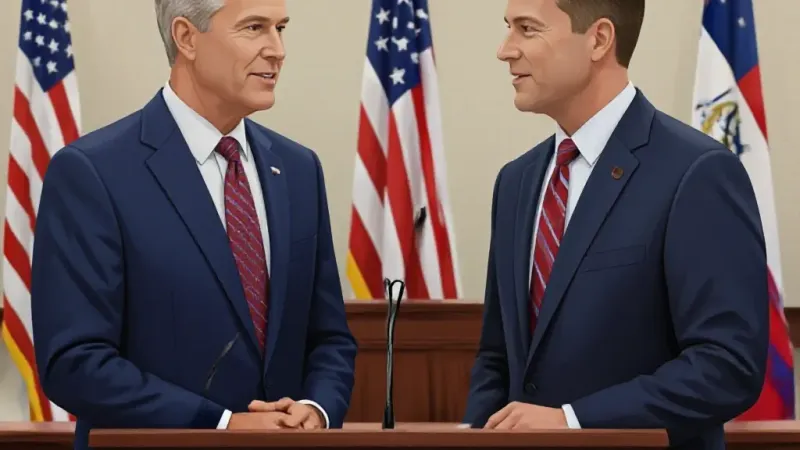
DOTHAN, Ala. – Alabama’s Democratic nominees for governor and lieutenant governor, former U.S. Sen. Doug Jones and Rep. Phillip Ensler of Montgomery, announced Wednesday a proposal to significantly change the role and powers of the state’s lieutenant governor. Their plan includes working with the Legislature to introduce a constitutional amendment that would reorganize state government, aiming to make the lieutenant governor an active partner in the executive branch.
Jones stated that he believes the lieutenant governor “always should be a part of the executive branch, a partner with the governor to help implement the administration’s policies.” He emphasized the current office often functions as a "figurehead in the Legislature that just sits with a gavel." A key component of their proposal is for the governor and lieutenant governor to be elected together on a single ticket, similar to the president and vice president of the United States. According to the National Lieutenant Governor’s Association, 27 states currently elect these two positions jointly.
Rep. Ensler, the Democratic nominee for lieutenant governor, joined Jones in the announcement. Ensler highlighted his existing bipartisan relationships within the Legislature, stating, “There is so much that I can do because of the relationships I have, as Doug said, across the aisle, and to be able to help carry out a vision, help fight for the people of Alabama.” Jones expressed his intention to involve the lieutenant governor, regardless of the November election outcome, as a team member with a "seat at the table," potentially in an advisory capacity or as an official cabinet member. He clarified that this arrangement would not constitute “double dipping,” referencing Section 280 of Alabama’s Constitution, which prohibits individuals from financially benefiting from two public offices.
The lieutenant governor’s role in Alabama has seen a significant decrease in power over the past two decades. The office once held powers comparable to the Speaker of the House, including control over legislation and the authority to assign senators to committees. However, these powers were largely stripped in 1999 following a prolonged disagreement between then-Lt. Gov. Steve Windom, a Republican, and the Democratic-controlled Senate. This dispute resulted in most of the lieutenant governor’s powers being transferred to the Senate President Pro Tem.
Further reductions in the office’s authority occurred this spring with the passage of Senate Resolution 108, sponsored by Sen. Arthur Orr, R-Decatur. This resolution allows the Senate President Pro Tem to preside over the Senate if the lieutenant governor has not taken their seat within five minutes of a scheduled meeting time. It also removed the lieutenant governor from the committee responsible for assigning committee chairs, ended their power to appoint members to conference committees, and granted the Pro Tem the power to recommit bills and direct the lieutenant governor to call up carried-over legislation.
This is not the first time lawmakers have sought to redefine the lieutenant governor’s role. Similar legislation was filed more than 20 years ago, though none of those proposals advanced to a floor vote in their respective chambers. Specific attempts include a proposal by Sen. Bobby Denton, D-Tuscumbia, in 1999; Rep. Mary Sue McClurkin, R-Pelham, in 2004; and then-Rep. Cam Ward, R-Alabaster, who filed proposals in both 2005 and 2006.
Jones and Ensler indicated they plan to collaborate with legislators in both the House and Senate to secure passage of their proposed amendment. Jones noted that he had "cleared it" with Senate Minority Leader Bobby Singleton of Greensboro and House Minority Leader Anthony Daniels of Huntsville. Daniels confirmed his support for the proposal in a phone interview, stating that the lieutenant governor, as a statewide elected official, should have duties that go beyond merely presiding over the Senate and could be “extremely valuable in the government.”
While Republicans currently hold a supermajority in both legislative chambers and have held the lieutenant governor’s office since 2010, Daniels expressed optimism that the proposal could garner bipartisan support. He suggested that such changes have likely been considered by both parties previously, but no action was taken, and "Someone has to start the conversation." Jones hopes to see the constitutional amendment move through the Legislature in time for voters to consider it in the 2028 election. Amendments require two-thirds support in each chamber of the Legislature and a simple majority vote from the public.