
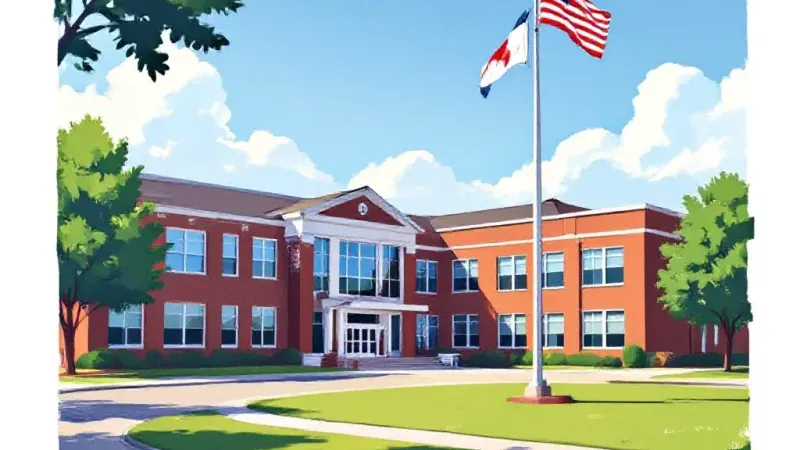
Alabama voters in November will consider amending the state constitution regarding daily recitation of the Pledge of Allegiance, student-led prayer, and weekly broadcasts of the National Anthem in public schools. The proposed changes, if approved, would affect K-12 public schools across Dothan, Houston County, and the wider Wiregrass region.
One of the measures, Amendment 3, requires school boards to adopt policies for the daily, voluntary recitation of the Pledge of Allegiance and for student-initiated and led prayer. The amendment, sponsored by Representative Reed Ingram, a Republican from Pike Road, passed the House of Representatives with a 94-3 vote last spring and received unanimous approval in the Senate with a 30-0 vote.
Representative Ingram stated in an interview that he had pursued legislation related to school prayer and the Pledge of Allegiance for several years. He explained that the amendment aims to ensure children understand their tax dollars fund their education and that the nation's identity as "America" is recognized. Regarding student-led prayer, Ingram said it would provide an opportunity for many children who may not have the chance to pray at home or attend church.
Alabama state law has required schools to conduct the Pledge of Allegiance each day since 1976, though students cannot be coerced into reciting it. Additionally, students are currently permitted to pray in public schools when not engaged in instructional activities. Ingram indicated that his amendment would safeguard these existing policies from potential lawsuits. He asserted that while the Pledge of Allegiance is current law, "a lot of schools are not doing it," and a constitutional amendment would "eliminate the litigation in the future." Ingram did not specify which schools he referred to. The proposed legislation does not compel students to participate in prayer or the Pledge.
Despite the voluntary nature outlined in the amendment, constitutional rights experts have raised concerns. Steven P. Brown, a professor of political science at Auburn University, suggested the provisions "could run up against some U.S. Supreme Court decisions." He specifically cited the 1943 case of *West Virginia State Board of Education v. Barnette*, where the Supreme Court ruled 6-3 that public schools cannot force students to salute the American flag or recite the Pledge. The Court's opinion at the time, delivered by Justice Robert Jackson, stated that no government official can dictate what is orthodox in politics, nationalism, or religion, nor compel citizens to declare belief through word or act.
Professor Brown also referenced the 2000 Supreme Court case *Santa Fe Independent School District v. Doe*, which determined that school districts cannot allow student-led, student-initiated prayer over public address systems before high school football games. Brown expressed concern about the potential for local government and school "editorial discretion" if, for instance, a student wished to lead a non-Christian prayer. When asked about such a scenario, Ingram responded that he did not foresee it, anticipating "more of the Christianity and that type," and dismissing concerns as a "fear factor." He added that policies would be "set up by the school boards."
The League of Women Voters of Alabama has voiced opposition to Amendment 3. Kim Bailey, president of the League, stated that the primary concern is "impinging on people’s rights" and preventing individuals from making their own choices.
The second measure, Amendment 4, sponsored by Representative Gerald Allen, a Republican from Cottondale, would require school districts to play the first stanza of the National Anthem weekly. Professor Brown showed less concern regarding this amendment, noting that it is "passive" and does not compel students to participate. A message sent to Representative Allen seeking comment on Tuesday did not receive a response.