
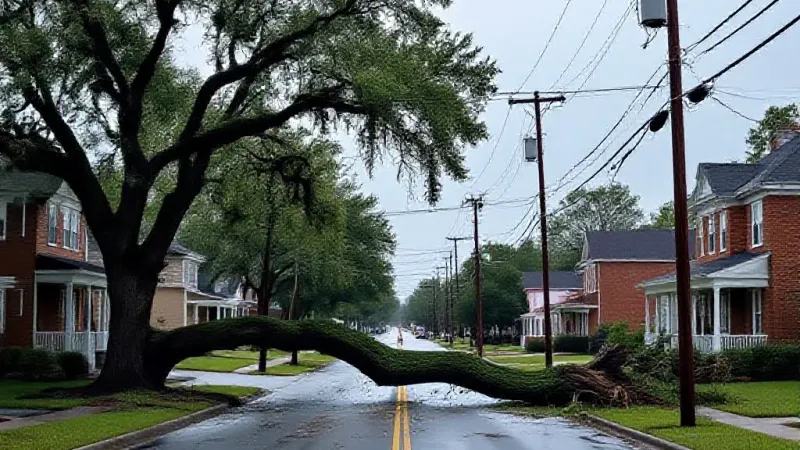
Hurricane Isaias, which made landfall as a Category 2 storm, was responsible for the deaths of at least two people in Alabama on Saturday as it brought heavy wind and rain across the state. The storm also left hundreds of thousands of Alabama residents without power and a trail of damage in its wake.
One fatality occurred in Birmingham on the east side of the city shortly after 5 a.m. Saturday morning when a tree fell onto a house, according to Shea Hess, an emergency management officer with the Jefferson County Emergency Management Agency.
Separately, a driver in Barbour County died following a motor vehicle wreck involving fallen trees. Josh Johnson, who works in external affairs with the Alabama Emergency Management Agency (AEMA), confirmed that the individual was transported from Barbour County to a medical facility in Dale County, where the death occurred.
As of 5:30 p.m. Saturday, approximately 127,000 customers were without power across Alabama, with the majority of these outages concentrated in the southern half of the state, according to poweroutage.us. Houston County reported 16,500 residents without electricity, Coffee County had about 15,000 customers awaiting power restoration, and Geneva County saw about 10,000 people without power. Nearly all of Conecuh County experienced a complete power outage by 5:30 p.m.
Alabama Power indicated that by 3:30 p.m. Saturday, more than 275,000 customers statewide had experienced storm-related outages. The utility also stated that over 60% of those affected customers had already had their power restored.
Governor Kay Ivey issued a statement late Saturday morning, expressing prayers for the loved ones of those who died and offering thanks to the crews working to clear debris and restore power. Her statement noted ongoing road closures due to downed power lines and specifically mentioned that crews were still working to reopen a portion of US-31 north of Brewton in Escambia County.
Isaias initially made landfall as a Category 2 Hurricane with sustained winds of 105 mph near Destin, Florida, at about 8:30 p.m. central time. The storm system's track subsequently shifted slightly east, impacting central Alabama. National Weather Service stations in Birmingham and Mobile received reports of damage throughout the evening. Jason Beaman, a meteorologist with the National Weather Service in Mobile, noted "significant trees and powerline damage" and widespread power loss in many inland counties due to heavy damage to power infrastructure.
Parts of Alabama experienced heavy rainfall, with counties in southwest Alabama receiving approximately 2 inches of rain, while areas to the east recorded about 8 inches. Enterprise, for example, received between 7 and 8 inches of rain. As of early Saturday afternoon, Isaias had been downgraded to a post-tropical cyclone with sustained winds of about 29 mph. There were no reports of tornadoes in Alabama, though northeast Alabama remained under a high wind warning until 7 p.m., and northwestern and central Alabama were under a wind advisory until 7 p.m.
Governor Ivey had previously rescinded an emergency proclamation that required non-residents in Baldwin and Mobile counties to evacuate the area. Additionally, on Friday evening, the Federal Emergency Management Agency (FEMA) announced that federal disaster assistance would be available for Baldwin, Escambia, and Mobile counties, as well as the Poarch Band of Creek Indians.