
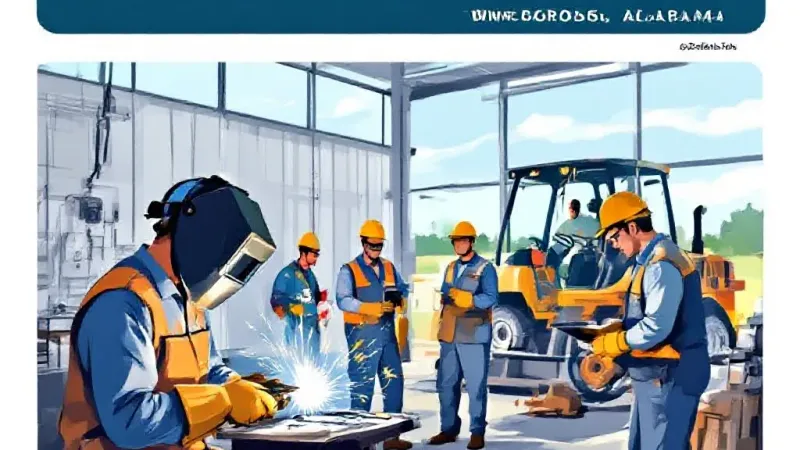
A new facility in Perry County has opened to provide expanded training for Alabamians on parole and probation, focusing on manufacturing jobs to address state labor shortages and aid re-entry into the workforce. The Perry County Probation and Parole Re-Entry Program Center, which began operations last week, will offer enhanced welding and heavy machinery training.
This initiative is a collaboration between J.F. Ingram State Technical College, which operates the facility, and the Alabama Bureau of Pardons and Paroles (ABPP). David Walters, president of J.F. Ingram State Technical College, emphasized the goal to "fine-tune their skills, getting them ready for what will be expected in the world of work" before individuals leave the program and return to society.
The job training is a key component of Re-Entry 2030, a rehabilitation program established by ABPP Director Cam Ward, which aims to reduce the rate of re-incarceration in Alabama. Ward noted that the likelihood of individuals returning to prison or jail "drop dramatically" once they secure employment.
The new facility specifically addresses limitations in previous training methods. Walters explained that while Ingram State offered welding, much of it was in a confined "welding box." The new center incorporates scaffolding to simulate diverse on-the-job scenarios, preparing trainees for conditions such as welding while on their back or at heights of 50 to 60 feet. This ensures they can properly meet employer requirements on construction sites and other workplaces.
Furthermore, the facility allows for uninterrupted heavy machinery training. Previously, outdoor training had to be suspended during inclement weather. With the new indoor space, Walters confirmed that training can continue "rain, cold or hot weather, whatever it is." The building features a large, barren dirt floor area where students will practice operating equipment like skid steers, backhoes, and small bulldozers. This practical training aims to prepare individuals for construction roles, contributing to the state's infrastructure development.
Walters highlighted a persistent shortage of workers with specific vocational skills throughout Alabama, noting that the state's workforce participation rate has lagged the national average for decades. In August of this year, Alabama's seasonally adjusted workforce participation rate was 56.8%, according to data from the St. Louis Federal Reserve, making it the fourth-lowest among U.S. states.
Both Walters and Ward anticipate a continued expansion in the number of jobs requiring welding skills. Ingram State and ABPP are partners in a $4 million grant from the Alabama Department of Workforce. This grant is designated to provide job training for people with a criminal history and to recruit them into skilled labor jobs, including shipbuilding.
Specifically, the grant will enroll 550 adults, aged 25 or older, in job training over 42 months in Mobile and Baldwin counties. This initiative connects to local industry needs, such as Austal USA, which recently secured a $450 million contract from General Dynamics Electric Boat to expand its facilities. Austal USA is recruiting workers to build components for U.S. Navy nuclear submarines. Walters emphasized the importance of ensuring skilled individuals for these crucial components, noting that the "justice-involved population is already a population with some barriers, and they are sometimes overlooked for job opportunities." The program aims to demonstrate the opportunities available through Ingram State.