
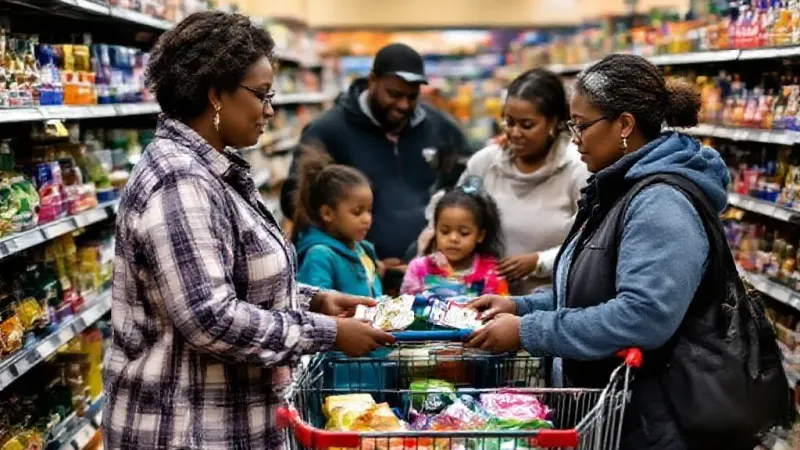
Alabama's grocery tax repeal, once considered a political longshot, has become a prominent bipartisan issue in the state's fall election campaigns. The move towards eliminating the sales tax on food has gained traction among candidates across the political spectrum, attracting support from both Democratic and Republican nominees for statewide office.
Long championed by anti-poverty advocates and Democrats, efforts to reduce the tax have recently been sponsored by Republicans as well. John Wahl, the Republican nominee for lieutenant governor, made the issue a core part of his primary campaign this spring. Similarly, Democratic gubernatorial nominee Doug Jones has centered the grocery tax repeal in his outreach to voters, stating that Democrats have advocated for its elimination "well over 20 years." Phillip Ensler, the Democratic nominee for lieutenant governor, also voiced support for eliminating the tax during his time in the House of Representatives, voting for its reduction in both 2023 and 2025. Ensler noted that support for cutting the tax is "overwhelming" across the state, regardless of location or political leaning, as people face financial difficulties. Wahl expressed concern for struggling families and seniors on fixed incomes, aiming to help them afford basic necessities.
Notably, Republican gubernatorial nominee Tommy Tuberville, who had largely overlooked the issue during his primary campaign, endorsed its "elimination" in his first general election advertisement. He described it as the initial step in a broader program of tax cuts. However, Tuberville's campaign website did not explicitly list cutting the grocery tax among his priorities as of early Friday afternoon, and messages seeking comment from his campaign on Thursday and Friday were left unanswered.
Alabama is one of eight states that still levy a tax on food, a practice that dates back to the introduction of the state's sales tax in 1939. Until 2023, Alabama was one of an even smaller number of states that fully taxed groceries. Anti-poverty groups, such as Alabama Arise, have consistently argued that the tax disproportionately affects low-income households and contributes to food insecurity, with the combined state and local taxes potentially reaching up to 10% of a grocery bill in many areas. Chris Sanders, a spokesman for Alabama Arise, emphasized the tax as a "human issue, a moral issue," given that everyone requires food to survive. Benjamin Meadows, an assistant professor of economics at the University of Alabama at Birmingham, explained that individuals with limited means pay a higher proportion of their income towards such taxes.
The tax has historically been a significant source of revenue for the state’s Education Trust Fund (ETF), which finances the majority of public education in Alabama. Efforts to eliminate the tax have been complicated by the challenge of replacing this substantial revenue. According to the Legislative Services Agency, the sales tax on food is projected to bring $393.5 million to the Education Trust Fund in 2025. This year, through August, sales tax collections on food totaled $207.6 million, with total annual collections expected to be around $230 million. This year's figure is artificially lower due to a two-month sales tax holiday on food in May and June, which coincided with state primary and runoff elections. The full elimination of the remaining 2% state sales tax on food would cost approximately $270 million in lost revenue. Meadows also noted that grocery taxes are effective revenue generators because groceries are considered "inelastic goods," meaning consumer behavior changes little even with price adjustments.
Despite the revenue implications, Alabama has begun to reduce its grocery tax. The Republican-controlled Legislature in 2023 reduced the state tax on groceries from 4% to 3%, and it is scheduled to be cut further to 2% in 2025. Local grocery taxes, however, have been frozen but remain in effect. Republicans have presented these reductions as a measure to combat inflation. Sen. Andrew Jones, R-Centre, who led efforts to reduce the tax in the Alabama Senate, expressed his belief that "the first thing we need to do on a state level is eliminate the rest of the state grocery tax."
Rep. Danny Garrett, R-Trussville, who chairs the House Ways and Means Education Committee, which oversees levies contributing to the ETF, confirmed that a bill has been drafted to eliminate the remaining state portion of the grocery tax. Garrett stated that when the first 50% was eliminated, the goal was to eventually eliminate the remainder. His plan for full repeal does not currently include a provision to replace the lost revenue, with Garrett indicating that "revenue growth" and budget review would address the shortfall.
The debate over replacing lost revenue has long been a hurdle. In 2008, a constitutional amendment to fully eliminate the state grocery tax passed the Alabama House of Representatives, then controlled by Democrats, but failed to secure the necessary votes in the Democrat-controlled Senate. Subsequent efforts received little attention until 2023.
Some alternatives have been proposed to offset the potential impact on the ETF budget. Alabama Arise, for instance, advocates for eliminating the federal income tax deduction, a proposal that has long been supported by Democrats alongside calls for grocery tax repeal. Chris Sanders described this deduction as a "highly skewed, highly upside-down tax break" that primarily benefits wealthy households. Separately, Doug Jones suggested eliminating the CHOOSE Act, which provides tax credits of up to $7,000 per child for non-public school activities, including private school tuition. Jones argued that lifting caps on taxpayer money for private schools for the state's wealthiest residents could significantly offset the lost revenue.
While the lieutenant governor position holds "little power to address the tax," the issue remains a prominent campaign point for nominees like Phillip Ensler and John Wahl, who largely agree on the need to eliminate the tax.