
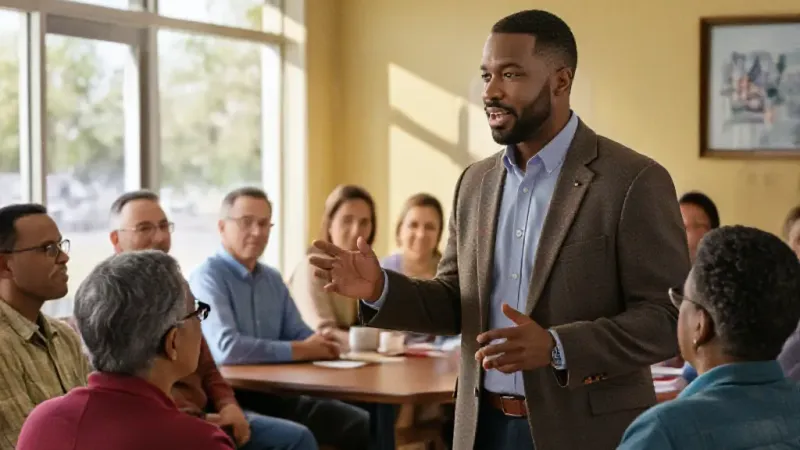
Everett Wess, the Democratic nominee for U.S. Senate, continues to campaign across Alabama, engaging with voters despite facing what political analysts describe as significant disadvantages in his bid to become the state's next senator. The election, set for approximately a month and a half from now, will determine the successor to U.S. Sen. Tommy Tuberville, who is the Republican nominee for Alabama governor.
Wess is attempting to be the first Democrat elected to the Senate from Alabama in a general election since 1992. His campaign faces Republican nominee Barry Moore, a congressman from Enterprise, who holds both name recognition and a substantial financial advantage. Federal Election Commission data shows that through the end of June, Wess had raised slightly less than $4,000 in campaign funds. In contrast, Moore had received almost $2.5 million in donations.
Political forecasts underscore the challenge for Wess. The Cook Political Report rates the Alabama Senate seat as "Solid Republican," while Sabato Crystal Ball designates it "Safe Republican." J. Miles Coleman, associate editor for Sabato Crystal Ball at the University of Virginia, described Alabama as "a tough state to start out with" for Democrats. Coleman noted that President Donald Trump carried the state by 30 points in 2024, and national parties do not appear heavily invested in the contest.
Alabama's voter demographics also lean heavily Republican. While the state does not require party registration, the Independent Voter Project, a nonprofit promoting election reform, estimated that nearly 2 million Alabamians, roughly 55% of the electorate, favor the Republican Party. About 1.2 million people, or 36%, tend to favor Democrats. This partisan split was evident in the May primary election for this race, where over 480,000 voters cast ballots for Republican candidates, compared to approximately 340,000 who voted for Democratic hopefuls.
Despite these structural disadvantages, Wess maintains his focus on meeting with citizens across Alabama to discuss his priorities for the state. He indicated in a recent interview that his approach is to "work on winning this election for the people of Alabama" by listening to their concerns. Wess said he chose to run after sensing widespread dissatisfaction with Trump’s performance and an "uncertainty with the current administration" among voters.
A central theme of Wess’s campaign, echoing priorities of other Democratic nominees, is the economy and inflation. He attributes rising costs to trends that began when Trump took office, noting that prices "have really not come down, and especially with the start of the (Iran) war." Wess cited high prices for gas, groceries, and prescription drugs. He also highlighted issues with a budget reconciliation bill signed into law by Trump, which shifted Supplemental Nutrition Assistance Program (SNAP) costs to states and did not extend Affordable Care Act health insurance tax credits previously allowed by former President Joe Biden.
Wess, an attorney for the Wess Law Firm in Birmingham, has outlined healthcare, public safety, and education as his top priorities if elected. He proposes bringing federal funding to rural parts of the state to invest in rural hospitals, strengthen their emergency departments, recruit additional medical staff, and make prescription drugs and healthcare more affordable for residents. Wess recounted a conversation with a woman who noted bread prices had increased by a dollar since the beginning of the year.
Historically, Democrats have occasionally overcome the Republican advantage in Alabama, as seen with Doug Jones's 2017 special election victory. However, that contest was the only one on the ballot, and Jones's opponent, former Alabama Supreme Court Justice Roy Moore, faced allegations of sexual abuse and misconduct, which he denied, and had alienated many Republicans. David Niven, an associate professor of political science at the University of Cincinnati, commented that a candidate can "neutralize your party’s advantage" if they are "extraordinarily, personally noxious to people" and face a credible opponent.
Wess has also served on the executive committee of the Jefferson County Democratic Party, taught classes at Faulkner University, and served on the board of Legacy Works, an organization focused on mentoring at-risk youth. Despite the significant odds, Wess expressed confidence in his strategy, stating he believes "on the ground working, listening to the people and listening to the needs and desires of the people" will ultimately make a difference in the race. He concluded, "I thought I could put the Alabama citizens first before the wants and the needs of the administration."