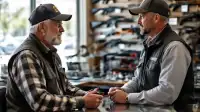
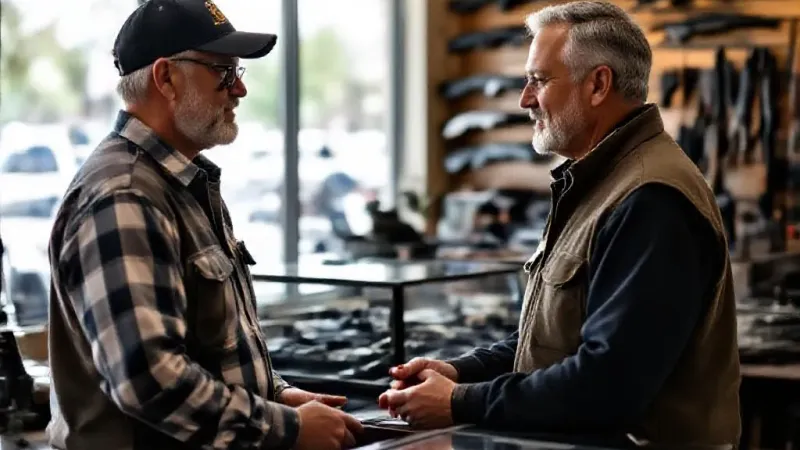
Alabama veteran suicide prevention advocates are expanding a program that recruits firearm retailers to offer safe gun storage for veterans feeling at risk of taking their own lives. Statewide, 14 gun retailers across 10 counties have already agreed to participate in the initiative, with gun safes expected to be placed in these stores by the end of the month.
The program is spearheaded by S.A.F.E.R. Together, an initiative focused on preventing veteran suicides. Jason Smith, the organization's founder and chair, stated the ultimate goal is to have "at least one" participating retailer in each of Alabama’s 67 counties, with a target of two per county. Smith said the organization expects to sign up a total of 20 firearm retailers by the end of this year. He is actively seeking more gun shops to join, particularly in areas with high suicide rates, such as Tuscaloosa, Mobile County, and Calhoun County.
This effort comes as the Alabama Department of Veterans Affairs launched its Operation We Remember campaign on Wednesday, honoring veterans in the state who have died by suicide. As part of the campaign, staff laid down 150 flags to memorialize veterans who lost their lives to suicide in 2024.
The need for such programs is underscored by stark statistics on veteran suicide. According to the Alabama Department of Public Health, the state’s overall suicide rate in 2021 was 20.1 per 100,000 people. However, for veterans in Alabama that same year, the rate was significantly higher at 35.4 per 100,000. The U.S. Department of Veterans Affairs highlights that veterans often face elevated risk factors for suicide, including financial challenges like unemployment or homelessness, pain or trauma stemming from their service, and difficulties adjusting to civilian life after military service.
Sandra Lucas, deputy commissioner of the Alabama Department of Veterans Affairs, emphasized the challenges veterans face during this transition. She explained that moving to the civilian world removes the structured environment of military life, leaving individuals in "a spot you are not trained for," which can be overwhelming, especially when combined with other life stressors.
Firearms play a significant role in suicide deaths in Alabama. Data from the Centers for Disease Control and Prevention (CDC) indicates that Alabama ranked fourth in the nation for firearm mortality in 2024, with 23.7 deaths per 100,000 total population, trailing only Mississippi, New Mexico, and Alaska. The American Foundation for Suicide Prevention reported that 73% of suicides in Alabama in 2024 involved a firearm, and 48% of all firearm deaths that year were suicides.
The safe storage initiative is supported by recent state legislation. In 2025, the Alabama Legislature passed SB 40, sponsored by Senator Keith Kelley, a Republican from Anniston. This law allows gun owners to enter an agreement with a gun shop owner to temporarily take possession of a firearm and keep it for an agreed period before returning it. The legislation also provides legal protection for gun shop owners, shielding them from liability after the firearm is returned to the individual who surrendered it.
Senator Kelley issued a statement on Wednesday, appealing directly to Alabama’s gun dealers. "I am asking Alabama’s gun dealers to step up and help us save lives," Kelley said. He added that gun dealers, with their understanding of firearms and responsible ownership, are uniquely positioned to offer a "safe place" when someone needs to temporarily separate from their gun.
Efforts to expand the program are targeting specific counties. According to data from the National Institutes of Health (NIH), Calhoun County had the fourth-highest suicide rate in Alabama between 2020 and 2024, with 22.9 suicide-related deaths per 100,000 total population. Cleburne County recorded the highest rate during this period, at 31 deaths per 100,000 total population. Jason Smith is specifically looking to recruit more gun shops in Calhoun County, along with Tuscaloosa and Mobile County, to broaden the reach of the safe storage program and address these critical needs.