
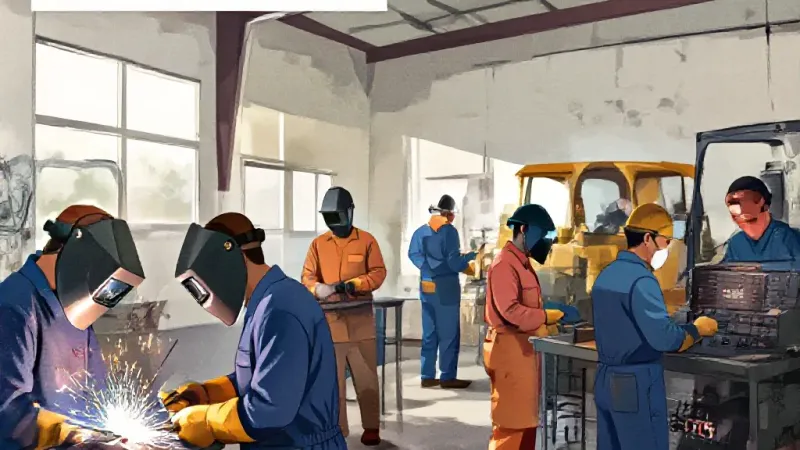
A new training facility recently opened in Perry County, designed to equip individuals on parole and probation with skills for manufacturing jobs while also preparing them for employer expectations. The Perry County Probation and Parole Re-Entry Program Center, which began operations last week, expands crucial training opportunities in welding and heavy machinery.
This initiative is part of a broader state program focused on providing job training in fields experiencing labor shortages. J.F. Ingram State Technical College operates the new facility in partnership with the Alabama Bureau of Pardons and Paroles (ABPP).
David Walters, president of J.F. Ingram State Technical College, stated the facility is intended to refine participants' skills, readying them for the demands of the modern workforce before they re-enter society. Cam Ward, director of the ABPP, established Re-Entry 2030, a rehabilitation program which includes this job training, with the goal of reducing recidivism statewide. Ward noted that the likelihood of individuals returning to prison or jail significantly decreases once they secure employment.
The new facility specifically enhances welding training capacity. Walters explained that while Ingram State already offers welding, much of the previous training occurred in a 'welding box' environment that did not accurately reflect real-world job conditions. He cited examples from welders who recounted working on their backs for hours or welding on beams 50 to 60 feet above the ground, often with other workers above and below them. To better emulate these scenarios, the new center will feature scaffolding, allowing students to practice welding in diverse positions to meet employer requirements on job sites.
Training for heavy machinery operation also sees significant improvements. Previously, staff conducted heavy equipment training outdoors, which required suspending sessions during inclement weather. The new indoor facility will eliminate this barrier, allowing training to continue uninterrupted, regardless of rain, cold, or heat, Walters affirmed. The building features a barren, dirt floor across most of its area, providing space for students to practice operating machinery such as skid steers, backhoes, and even small bulldozers. The ultimate goal for this training is to prepare individuals for placement on construction sites, contributing to the state's infrastructure development.
Walters highlighted that businesses across Alabama continue to face a shortage of workers with specific vocational skills. Alabama's workforce participation rate has consistently lagged behind the national average for decades. Data from the St. Louis Federal Reserve shows Alabama's seasonally adjusted workforce participation rate was 56.8% in August of this year, making it the fourth-lowest among states, only above Mississippi (54.7%), New Mexico (56.7%), and West Virginia (53.8%).
Both Walters and Ward anticipate a continued expansion in jobs requiring welding skills. The ABPP and Ingram State are partners in a $4 million grant from the Alabama Department of Workforce. This grant aims to provide job training for 550 adults, at least 25 years old, with criminal histories, and recruit them into skilled labor positions, including shipbuilding. According to a news release earlier this month, this program will run for 42 months in Mobile and Baldwin counties.
Walters pointed to Austal USA as an example of current demand. The company secured a $450 million contract from General Dynamics Electric Boat to expand its facilities and build components for U.S. Navy nuclear submarines, and it is actively recruiting workers for these roles. Walters emphasized the importance of skilled workers for such critical components and noted the intention to reach the justice-involved population, who often face barriers and are overlooked for job opportunities. He said Ingram State aims to demonstrate its capabilities to this population.