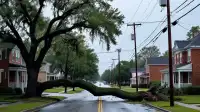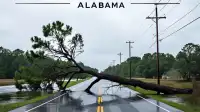

Hurricane Isaias claimed two lives in Alabama and knocked out power to nearly 300,000 customers statewide over the weekend, battering the Wiregrass region despite a late shift east that spared Alabama’s immediate coastline a direct hit. By Sunday afternoon, utility crews had restored power to more than 80% of the affected customers.
Governor Kay Ivey confirmed the two Alabama deaths Saturday morning. One fatality occurred when a tree fell on a home in east Birmingham early Saturday, according to Shea Hess, an emergency management officer with the Jefferson County Emergency Management Agency. A second person was rescued from that same home. In Barbour County, a driver died following a wreck that involved fallen trees, as stated by Josh Johnson, who works in external affairs for the Alabama Emergency Management Agency. Across Alabama and Florida, at least four deaths were reported.
Alabama’s electric providers worked quickly, restoring power to a significant majority of customers knocked offline by Isaias within about a day and a half. On Saturday morning, PowerOutage.us identified 297,684 Alabama customers without electricity. This number dropped to 50,800 by Sunday afternoon. Alabama Power, which had staged over 5,700 outside workers from 25 states before landfall and increased that force to more than 6,400 as the storm moved inland, reported that more than 267,000 of its customers lost service. Over 130,000 of these customers had their power restored by 11 a.m. Saturday, hours after the storm crossed the state. About 31,000 Alabama Power customers remained without service late Sunday morning, according to Alabama Media Group reports from the company’s outage map. Alabama Power stated its expectation that at least 95% of outages would be restored by midnight Sunday. Rural electric cooperatives also moved swiftly to restore service.
Summerdale-based Baldwin EMC restored more than 49,000 meters by Sunday morning, accounting for approximately 95% of its knocked-out connections, with nearly 300 contract and mutual aid line workers from other cooperatives assisting. Mark Ingram, Baldwin EMC’s vice president of corporate services and public relations, noted that “Having extra boots on the ground helps us get those resolved faster.” Hartford-based Wiregrass Electric Cooperative and Andalusia-based Covington Electric Cooperative each experienced service losses for about two-thirds of their members, according to the National Rural Electric Cooperative Association. Wiregrass Electric managed to cut its outages in half by Sunday, reducing them from about 18,000 to approximately 9,000. Dothan Utilities saw about 16,700 customers without power Saturday morning, with roughly 3,000 outages remaining by Sunday morning. The Alabama Emergency Management Agency confirmed Sunday that restoration work had significantly pushed outages well below the storm’s peak.
Hurricane Isaias made landfall near Destin, Florida, around 8:30 p.m. Friday as a Category 2 hurricane, bringing sustained winds of 105 mph, according to the National Hurricane Center. While an earlier track pointed closer to the Alabama-Florida line, the storm shifted east. Isaias weakened to a post-tropical cyclone over Alabama early Saturday. The Alabama Emergency Management Agency traced the worst damage to a “sting jet” of wind that caused trees to fall across southwest Alabama. Governor Ivey expressed gratitude to the crews positioned statewide for their efforts to clear debris and restore power. In southeast Alabama, winds approached 70 mph, WTVY reported.
Dothan Mayor Mark Saliba commented on the damage, comparing it to Hurricane Michael in 2018. He stated on Facebook that the city took “a hit that was surprisingly worse than Michael.” In Geneva County, Bellwood recorded 12.97 inches of rain in 13 hours, the highest total in early Weather Prediction Center reports published by the Weather Channel. Brian Smith, Geneva County EMA Director, announced that the Choctawhatchee River at Geneva is projected to crest Monday at 27.5 feet, exceeding its flood stage of 23 feet. Due to power outages, Geneva County Schools will be closed Monday.
A Dale County sheriff’s deputy sustained minor injuries when a tree fell on him at a crash scene. In Greenville, a tree fell on a home, trapping a family inside, though no serious injuries were reported. Greenville Police Chief Justin Lovvorn described it as “a situation that could’ve gone really bad really quick.” As of Sunday morning, no tornadoes had been reported in Alabama.
Governor Ivey had spoken Saturday with Federal Emergency Management Agency Administrator Cameron Hamilton, her office reported, and confirmed that all major roadways in the state had reopened. She also rescinded the order that had required visitors to leave parts of Mobile and Baldwin counties. Gulf Shores & Orange Beach Tourism announced Sunday that the beaches had reopened with minimal damage. The state lifted mandatory evacuation orders for Gulf Shores, Orange Beach, and Fort Morgan. A 75 mph gust was recorded near Orange Beach. Orange Beach Mayor Tony Kennon expressed relief, stating, “We dodged a bullet, and we thank God for that.” Gulf Shores Mayor Robert Craft confirmed that many businesses had reopened Saturday. The Port of Mobile, which had been closed to vessel traffic since early Friday, reopened Saturday afternoon after the U.S. Coast Guard set Port Condition Normal. Mobile County lifted its local state of emergency at noon Saturday.
Isaias marked the first hurricane of the 2026 Atlantic season and tied a 1905 storm for the latest first hurricane of a season on record. It was also the first hurricane to make landfall on the U.S. mainland since Milton in October 2024. Governor Ivey’s state of emergency for 40 counties is set to remain in effect through Wednesday unless she extends it.